- Design
- Green Building
- Interviews
Manini case study: a bio-based timber villa built in 2016 in the province of Cremona, certified CasaClima A and presented through its executive design, construction, building envelope, site work, systems and living comfort.
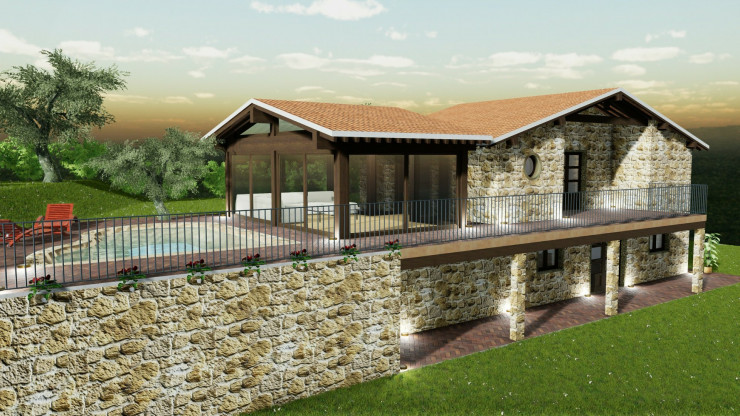
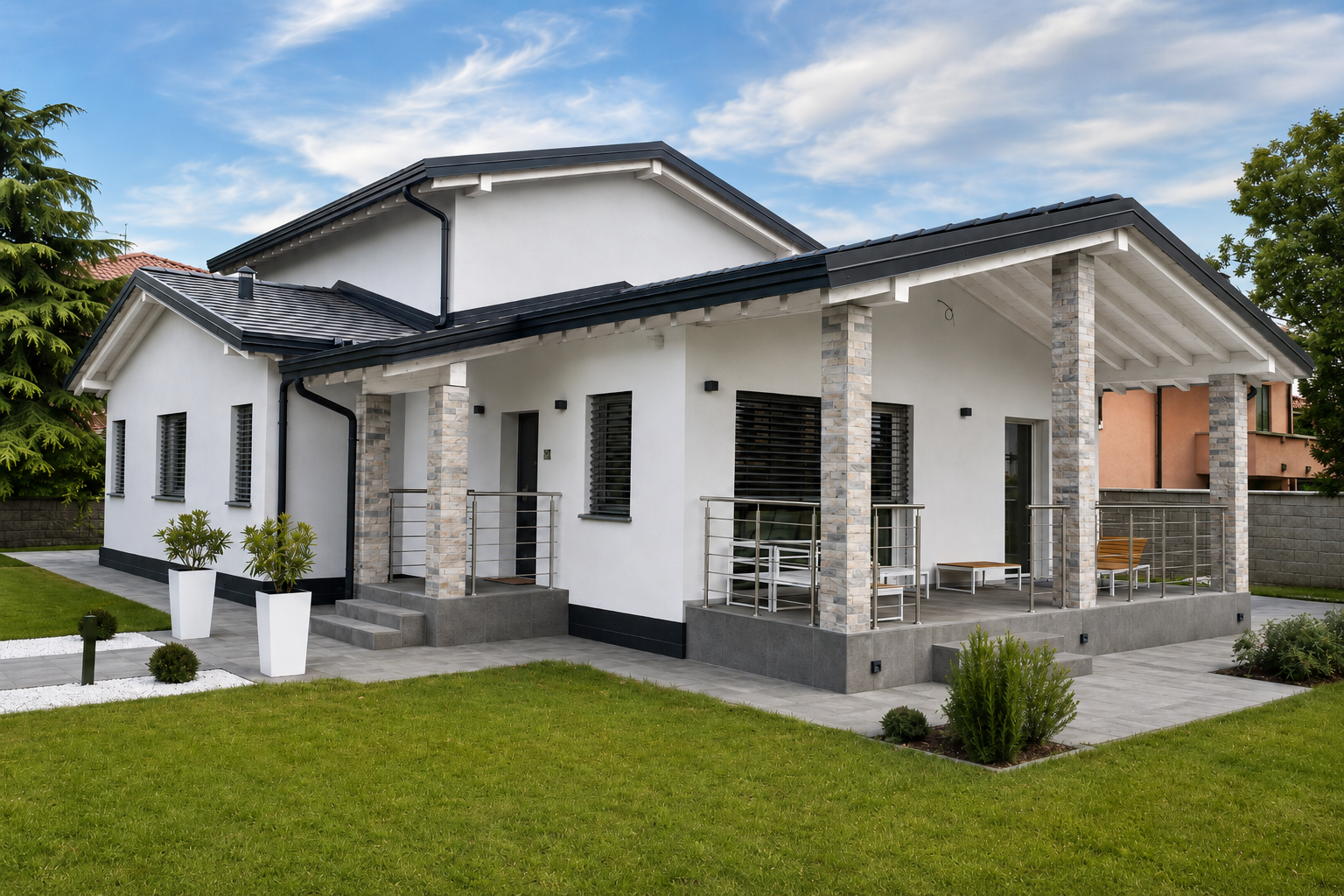
Timber villa in Rivolta d’Adda (CR), built in 2016 and certified CasaClima A.
In summary
This timber villa is located in Rivolta d’Adda, in the province of Cremona, and was built in 2016.
The building is certified CasaClima A and is a useful case study for understanding how a high-energy-performance timber home is created.
Manini handled the executive design and construction, following the phase in which technical choices become a real building.
The project combines contemporary architecture, bio-based construction, control of the building envelope, careful installation, blower door testing and living comfort.
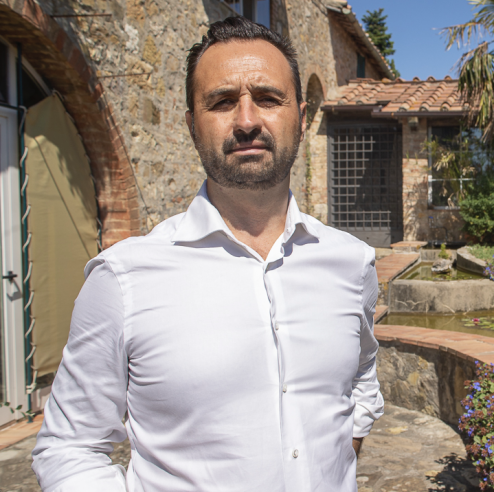
The interview with architect Alberto Grimaldi, CasaClima consultant, explores the certification process, site inspections, airtightness and system choices.
A CasaClima A certified timber villa built in Rivolta d’Adda
In 2016, in Rivolta d’Adda, in the province of Cremona, a timber villa was taking shape, designed to combine contemporary architecture, energy efficiency and execution quality. It was not an obvious choice. At the time, high-performance timber homes were already part of the technical debate, but they had not yet gained the commercial visibility they would acquire in the following years.
This house therefore belongs to a very specific moment: a time when building with bio-based construction methods meant making a conscious choice, often different from the habits of the market. The result is a CasaClima A certified villa, built with careful work on the envelope, airtightness, construction details, systems and indoor comfort.
It is not a theoretical example of bio-based construction: it is a house that was built, verified, certified and is still useful today for understanding what distinguishes a well-executed timber building from a simple commercial promise.
The role of Manini: executive design and construction
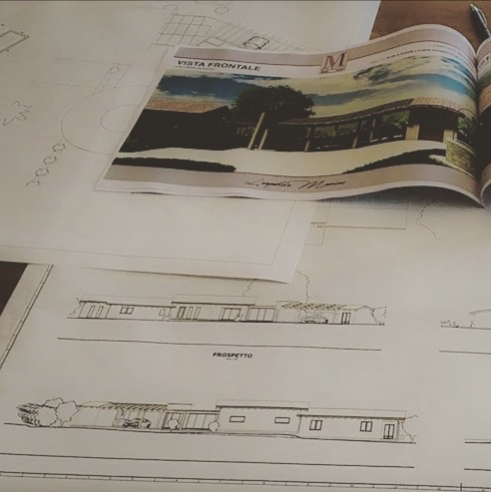
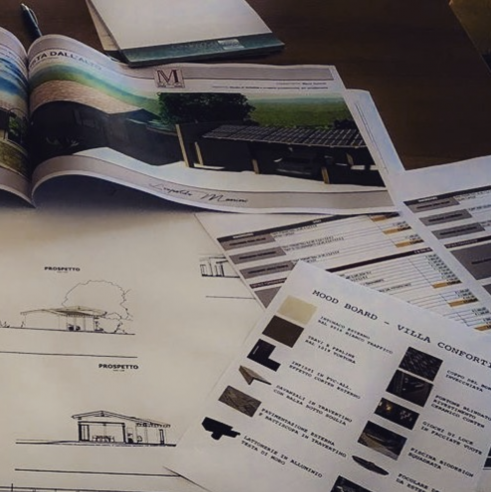
In this project, Manini handled the executive design and construction of the building. It was not a simple supply contract or a partial intervention, but work carried out in the phase where technical quality takes shape: construction details, installation, site coordination and final execution.
This point is essential for reading the case study correctly. In a high-energy-performance timber house, quality does not depend only on the initial idea or on the chosen material. It depends on the consistency between what is designed and what is built: wall build-ups, tapes, windows, external insulation, systems, connections and envelope penetrations.
Today, this villa is a tangible reference in Manini’s path dedicated to bio-based homes: a real building, constructed, inspected and certified.
Why a CasaClima A villa is not just a low-consumption house
When people talk about energy certification, there is a risk of reducing everything to a label. CasaClima A, however, is not just a numerical result. It is a control process that accompanies both the design and the construction site. The value of the certification lies precisely in the fact that the building is not assessed only after completion, but is followed through specific technical steps.
In the case of the Rivolta d’Adda villa, the design was analysed at the preliminary stage, construction details were checked, envelope choices were included in the specifications and the site was carefully monitored. The CasaClima auditor plays a decisive role: observing, checking and verifying that what was planned is actually carried out.
A high-efficiency home does not come only from a good drawing or from a high-performance material. It comes from consistency between design, specifications, site supervision, contractor and final verification. If one of these steps is neglected, the risk is having a building that promises a lot on paper, but in reality loses performance, comfort and value.
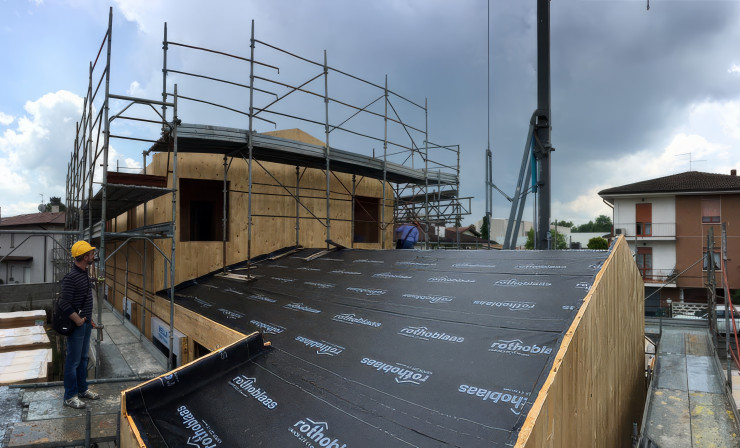
The timber house construction site: precision, airtightness and construction details
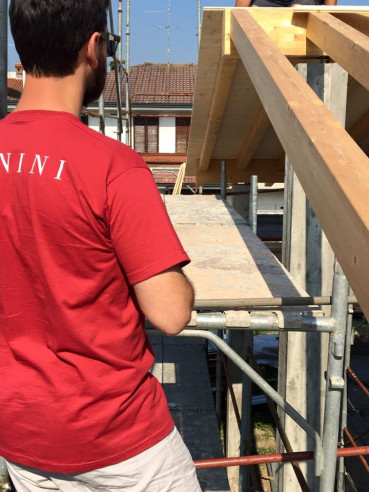
In timber construction, precision is not a secondary detail. It is part of the substance of the building. The junctions between walls, roof, windows, systems and foundations must be designed in advance and executed with care. Every system penetration, every joint and every uncontrolled air passage can affect the behaviour of the envelope.
During the construction of the villa, great attention was paid to airtightness. Tapes, membranes, seals and connections are not secondary elements: they are what allow a highly insulated house to function correctly. In an efficient building, uncontrolled air leakage can become one of the main critical points.
The site work also involved the external insulation system, window installation, system penetrations, continuity of the technical layers and thermal bridge checks. More than other technologies, a timber house requires the executive design to be followed with precision. It leaves very little room for improvisation.
In this case, careful execution made it possible to achieve a result consistent with the original objectives: a certified high-performance timber villa capable of offering real comfort in everyday life.
Blower door test: n50 approximately 0.59 at 50 Pa
One of the most significant moments in the certification of a high-performance house is the airtightness test, often known as the blower door test. This test places the building under pressure and depressurisation to measure how much uncontrolled air leakage is present in the envelope.
For a timber house, this step has particular value. It is not just about passing a test, but about confirming that the work carried out on membranes, tapes, windows, system penetrations and connections has been executed correctly. It makes measurable what would otherwise remain hidden inside the construction layers.
In the case of the Rivolta d’Adda villa, the interview transcript reports an n50 value of approximately 0.59 at 50 Pa. This is a highly significant figure because it shows the correspondence between design and construction: the performance did not remain on paper, but was verified on site.
A timber house that does not look like a chalet
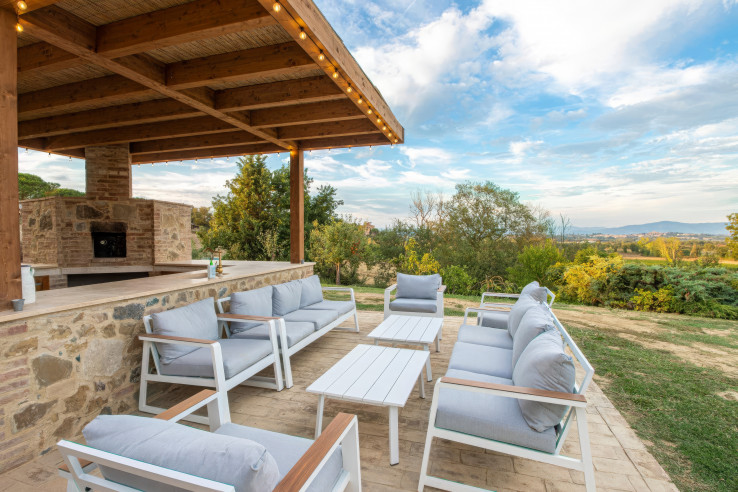
One of the most interesting qualities of this villa is its architectural appearance. From the outside, it does not communicate the stereotypical idea of a timber house as a chalet, mountain lodge or rustic building. On the contrary, it appears as a contemporary villa, with rendered façades, a dark roof, a porch, stone-clad pillars and a balanced, restrained, familiar architectural language.
This point matters because many people still associate timber with a mandatory aesthetic. In reality, the construction technology does not necessarily impose an image. A timber villa can look modern, classical, Mediterranean or minimal. The structure remains hidden within the construction system, while the architecture can respond to the client’s taste, the context and the project.
The Rivolta d’Adda villa demonstrates exactly this: bio-based construction does not need to look “alternative” in order to be such. It can be an elegant, recognisable house, well integrated into its setting and built according to advanced criteria.
Living comfort, indoor air and systems: the wellbeing that is not immediately visible
An efficient building is not measured only by consumption. It is also measured by the quality of life it creates inside. Temperature, humidity, clean air, absence of draughts, heat distribution and comfort stability are elements that the owner perceives every day, even without translating them into technical terms.
The villa was designed with a carefully developed envelope and a building services system consistent with the performance of the building. In the technical interview dedicated to the project, the presence of mechanical ventilation with heat recovery and thermodynamic management is explained, together with solutions designed to maintain good indoor air quality and a high level of comfort.
In a traditional house, the tendency is often to compensate for envelope weaknesses by increasing system power. In a well-insulated and airtight house, the logic changes: first the energy demand is reduced, then a proportionate system is chosen. This helps avoid oversized systems, unnecessary consumption and poorly balanced indoor conditions.
The presence of photovoltaics and battery storage completes the energy framework, contributing to a reduction in grid consumption and improving the overall behaviour of the home. The main point, however, remains the same: the system works well when the building has been well designed and well built.
What this villa teaches those who want to build with bio-based construction
This house teaches one simple thing: bio-based construction is not a commercial formula. It is not enough to say “timber”, to talk about efficiency, or to choose a natural material. To build well, design, expertise, control and careful execution are required.
Timber is an extraordinary technology, but it requires precision. It allows for fast construction times, excellent performance, low environmental impact and great living comfort. But it does not forgive superficial work. A poorly built timber house can generate significant problems, precisely because every technical junction has a specific function.
The CasaClima A villa in Rivolta d’Adda is therefore still a useful testimony today. Not only because it was built in 2016, but because it shows a way of working that remains relevant: starting from the design, defining performance targets, checking details, following the construction site and verifying the result.
For Manini, this project represents a significant step in the path dedicated to timber villas, bio-based construction and high-efficiency homes. A house built to be lived in well, not only to look good.
Quick answers for those searching for a CasaClima A timber villa
The CasaClima A timber villa in Rivolta d’Adda is a house built in 2016 in the province of Cremona. Manini handled the executive design and construction. The case study documents the building envelope, airtightness, blower door test, systems, mechanical ventilation and indoor comfort.
For those considering a high-energy-performance timber house, this project shows why certification, site execution and precision in the details are just as important as the choice of material.
Frequently asked questions about the CasaClima A timber villa in Rivolta d’Adda
What is a CasaClima A timber villa?
It is a villa built with timber technology and designed to achieve high energy performance according to the CasaClima protocol. In the case of the Rivolta d’Adda villa, the process involved design, site work, building envelope, systems and final verification.
Where is this CasaClima A villa built by Manini located?
The villa is located in Rivolta d’Adda, in the province of Cremona. It was built in 2016, is certified CasaClima A and Manini handled its executive design and construction.
What did Manini do in this project?
Manini handled the executive design and construction of the villa, following the technical and construction phase through to the CasaClima A certified result.
Does a timber house have to look rustic?
No. This villa shows that a timber house can have a contemporary appearance, with rendered façades, a dark roof, a porch and elegant finishes. The construction technology does not force a chalet-like aesthetic.
Why is the blower door test important in a timber house?
The blower door test verifies the airtightness of the building. It is used to check whether membranes, tapes, windows, connections and system penetrations have been executed correctly.
What is the value of CasaClima A certification?
CasaClima A certification does not merely declare an energy performance level. It introduces a verification process covering the design, the construction site and the final result, with checks that help protect the client.
Technical insight: interview with architect Alberto Grimaldi
The quality of a timber house is not measured only by its aesthetic result, but by the process that leads it to be built correctly. For this reason, as a complement to the case study, the interview with architect Alberto Grimaldi, CasaClima consultant, dedicated to this villa is also available.
The interview covers the certification process, site inspections, the airtightness test, system choices and the level of attention required to build a high-performance timber house correctly.
Watch the full interview with architect Alberto Grimaldi on the CasaClima A villa in Rivolta d’Adda
[Insert interview link here]
https://www.youtube.com/live/82FVy1mNm-s